Translate

Saturday, June 22, 2024

Beside the Volga

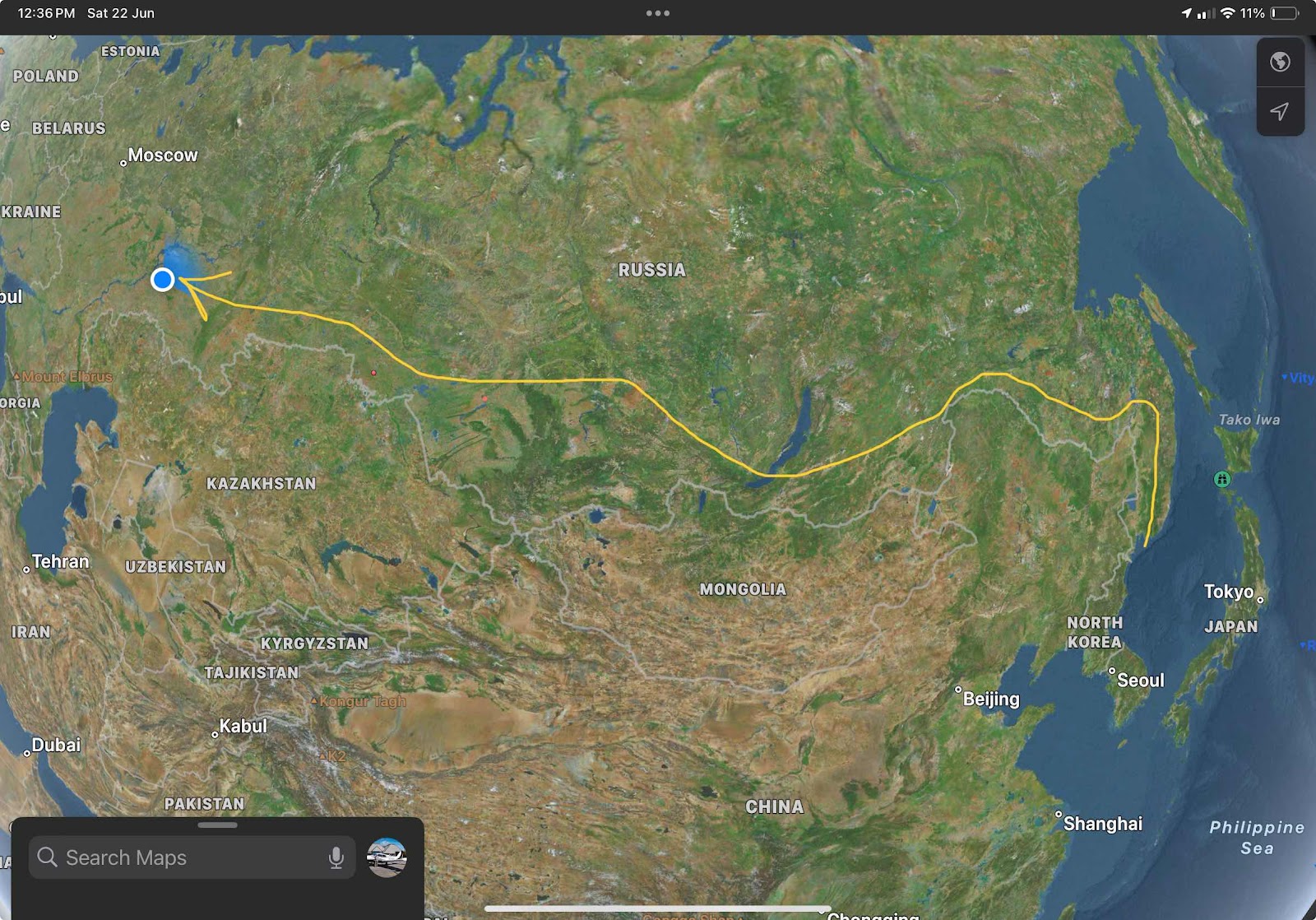
Here we were deep the historic heart of Russia, the city of Samara to be precise, walking along a grand promenade on the shore of the Volga River. It is said to be the longest promenade in Europe. Two weeks earlier I had been in the far east Russian city of Vladivostok looking out over the Sea of Japan. The distance in-between over which the trusty Comanche had flown in a little under two weeks, amounted to a staggering 3,000 NM (6,000 km). To put that distance in perspective, it is almost one and a half times across the mainland USA and we were still inside Russia, while sublimely conscious the Ukraine boarder was only a couple or so hours flying further to the west..!


The late afternoon temperature hovered in the mid-twenties, just perfect for walking as attested to by a constant parade of well attired locals. Many walked arm-in-arm, some with small dogs. There were families, laughing and smiling. Altogether the scene appeared serenely normal. Meanwhile, I was haunted by the memorable refrains of an embedded song. My mind momentarily wandered. “Yo, heave ho…as we walk along the shore..!” It was the stirring and well known traditional Russian song of the Volga Boatmen, sung by burlaps or barge-haulers, on the Volga River.


Widely regarded as the national river of Russia, the Volga served as an important meeting place during the middle ages for various Eurasian cultures, and before then it had been a penetrative route for Viking conquests. Quite understandable when this significant water-way, navigable for more than 2,000 miles, connects Northern Europe and Northwestern Russia with the Caspian Sea. And meeting people had also bought us to the shores of the Volga River. 


Samara is the home of AeroVolga, a niche designer and manufacturer of a range of single and multi-engine amphibian aircraft. During the summer of 2018, three of their aeroplanes successfully completed a 45-day Northern Polar global circumnavigation. In the spirit of aviation adventurers, we were generously welcomed and hosted. We even stood symbolically side-by-side looking out across the Volga River as the sun set on the western horizon.


It is a long way to fly across Russia


Walking the promenade beside the Volga


A bronze rendition of Ilya Repin’s famous painting Barge Haulers on the Volga


Sunset across the Volga



The AeroVolga Polar circumnavigation team


Baz, Bob with the AeroVolga management team


Sunday, June 2, 2024

Crossing the Climatic Equator

As a round the world and long-range flyer, Bazflyer is often asked; “What do you do while sitting in a small aircraft cockpit for eight or nine hours?” Well, the brief response is to say that it is by no means boring. Monitoring, checking and re-checking flight progress against the plan is a constant process. Engine parameters, ground speed and fuel consumption data are consistently reviewed. Then there are regular radio calls to make giving portion reports to the monitoring agency responsible for the airspace you’re flying in. High Frequency (HF) radio is commonly used to do this usually communicating with an operator thousands of miles distant. This was the case yesterday while flying eight hours from Mount Hagen north of the equator to the island of Guam. The radio operator was on the other side of the Pacific Ocean in San Fransisco. 

As well as the routine procedure of flying, a pilot also needs to be cognisant of the environment and yesterday that entailed penetrating and crossing the ever present Intertropical Convergence Zone (ITCZ). This band of equatorial weather is one of the most fascinating and influential features of Earth's atmospheric dynamics. Often referred to as the "climatic equator," this region plays a crucial role in shaping weather patterns and influencing the climate across the globe. But what exactly is the ITCZ, and why is it so important?

The ITCZ is a belt of low pressure that circles the Earth near the equator, where the trade winds from the Northern and Southern Hemispheres meet. This convergence of winds results in a band of intense cloud formation and precipitation. It is not a fixed line; it migrates north and south with the seasons, following the sun's zenith point and influences the monsoon systems in regions such as South Asia, West Africa, and Central America. Understanding the behaviour of the ITCZ is crucial for predicting weather patterns and managing water resources. 

Prior to commencing yesterday’s flight, satellite imagery provided Bob and Baz with advance knowledge of where the ITCZ was sitting. Even so, visually picking a safe route through this band of weather was another series of decisions and tasks added to the busyness of everything else. Next time the ITCZ is encountered it will be on the way back from Guam to Papua New Guinea, following an historic global circumnavigation and World Flight 100. Never let it be said; “Flying round the world in a small airplane is ever boring.”


Former Prime Minister of Papua New Guinea was among the well-wishers on departure from Mount Hagen

.

Bob broadcasts a position report on HF radio


Each check along the route is recorded


Picking a flight path through the ITCZ


That looks like blue sky ahead


And....after a long flight the sun goes down on Guam

Sunday, March 31, 2024

Breaking News

In the hurly burly of modern media, the theme of ‘breaking news’ resonates with the urgency and immediacy of an interconnected world. It encapsulates the dynamic nature of information dissemination, where stories unfold in real-time, grabbing attention and shaping perception. 

One hundred years ago in the aftermath of World War 1, the airplane and its rapidly advancing capabilities was often the subject of ‘breaking news’ around the world. Airplanes and their fearless pilots had conquered the Atlantic and flown from London to Australia. In 1924 the race was on to circumnavigate the globe by air.

This year marks the centenary of the first flight round the.world. https://www.firstworldflightcentennial.org/ Four Douglas Air Cruisers operated by the US Army Air Service, departed Seattle on April 6, 1924. They flew a westwards route that took them north to Alaska, along the Aleutian Islands to Russian Kamchatka and onto Japan. https://www.seattleworldcruiser.org/1924-world-flight-chronicle 

Three of the aircraft reached Kagoshima on 2nd June and from there they flew across China and India arriving in Brough, Yorkshire (near Hull in the UK), on 17th July. During the following two weeks, essential maintenance was performed and pontoons refitted in preparation for a continuation of the flight over the North Atlantic via Iceland and Greenland and onto the USA. 

One of the four planes crashed in Alaska, but the crew was rescued. A second aircraft ditched in the North Atlantic and the crew was picked up by the U.S. Navy.  The two remaining flight crews returned to a huge welcoming crowd in Seattle on September 28, 1924 after completing the epic 175 day, 26,345 mile journey and becoming the First to Fly Around the World.

So what is the significance of this..? Well, 2019 round the world flyer Barry Payne bazflyer.com will leave New Zealand later in May flying his trusty Piper Comanche, ZK-BAZ, to Mount Hagen in the Central Highlands of Papua New Guinea. Here he will be joined by good friend Bob Bates http://www.pngtours.com/tours/Bobsflights.htm. Together they will fly a westwards World Flight closely reenacting the original 1924 flight route.

Step one will have Barry and Bob flying north of the Equator to arrive in Kagoshima, Japan, at the same time the original flyers were there 100 years previous. They will then traverse Russia meeting many aviators across the land and carry onto the UK landing at Breighton Airfield which is close to Brough. They will leave the UK late August, retracing the original flyer’s air path over the North Atlantic, across the USA all the way back to Seattle. 

After Seattle , Barry and Bob pickup the original 1924 route through Alaska, down the Aleutian Islands to Kamchatka and complete a full circle at Kagoshima. They are scheduled to arrive back in Mount Hagen on 28th September, the same day the two Douglas Air Cruiser’s landed back at Seattle in 1924 completing the First Flight Round the World.

Barry and Bob proudly represent the South Canterbury Aero Club, Timaru Airport, New Zealand. Also for the record book, the two flyers have a combined age of 161 years, and 105 years pilot experience.

'Breaking News', Blogs and YouTube video along the journey can be accessed at www.bazflyer.com. Click "Follow" to be notified.

Preparing the trusty Comanche
for a second World Flight


Douglas Air Cruiser


The 1924 flight route


Bob and Barry (Baz)


Friday, September 15, 2023

Unsung Héros

 In a speech on August 20, 1940, Winston Churchill delivered his now iconic and famous line, "Never in the field of human conflict was so much owed by so many to so few”. He was of course, addressing the heroic efforts of the Royal Air Force and its pilots of various nationalities, who during World War II courageously fought in the Battle of Britain. 

The aerial battle raged for one-hundred days over the summer of 1940. A symphony of courage and determination that unfolded amidst the billowing clouds and echoing thunder of powerful aircraft engines. A sky full of Spitfires and Hurricanes, like agile dancers, pirouetting in a deadly duel with the Luftwaffe's menacing Messerschmitts. The skies above Britain became a canvas for a masterpiece of human resilience and valour. It was a battle not just of aircraft, but much more significantly, it was a testament to the triumph of human spirit against overwhelming odds. 


Eighty-three years after Winston Churchill’s speech, we still continue to ponder his words, particularly on Battle of Britain Day, commemorated annually on the 15th September. Just a small handful of the people addressed in his speech are still alive today. However, Churchill’s words are just as applicable to everyday life, in every community, everywhere.


All around us, often unnoticed, are selfless Individuals who willingly give up their own personal interests, comfort, or well-being for the greater good of society or a specific cause. This can take many forms, such as individuals dedicating their time, resources, or even their lives to help others, to resolve conflicts or advance particular social or humanitarian goals. 


Unsung hero’s seamlessly interlace every community and immeasurably enhance our everyday life. So, in an adaption of Winston Churchill’s words…”Everywhere on every day, so much is owed by so many of us to so few”.


A couple of hero's from the Battle of Britain. F/O Alan (Al) Deere (NZ) & F/O Colin Townsend Gray (NZ) - 54 Squadron RAF


Everyday heroes in our community...paramedic volunteers helping the the sick and injured. 


The summit of Mt Cook is 3724m (12.217 ft). It is literally the top of New Zealand and you can’t get any higher in the New Zealand to rescue anyone. The injured man was stuck on the very top of the mountain. 

Taupo based Greenlea Rescue Helicopter attending an accident scene where a person sustained multiple serious injuries. 


Spitfire as flown in the Battle of Britain (New Zealand Air Force Collection) 

Sunday, April 30, 2023

First of May

Tomorrow is the 1st of May and ‘Down Under’, using the Southern Hemisphere colloquialism referring to New Zealand and Australia, this day signals the end of summer weather with the next winter waiting in the wings.


In a Northern Hemisphere environment the 1st of May, also known as May Day, traditionally celebrates Spring and the coming of Summer. In some countries it is recognised as a day to honour workers.


However, for myself, the day always brings to life that hauntingly beautiful song, “The 1st of May”, written and sung by Robin Gibb one of the three brothers who made up the Bee Gees. I well remember the song being released in 1969, it was the same year I begun flying as a pilot in the Royal New Zealand Airforce. 


The song’s lyrics emotionally describe the passing of time, the joy and renewal it brings and the importance of appreciating life's fleeting moments.


Now we are tall, and Christmas trees are small

And you don't ask the time of day

But you and I, our love will never die

But guess we'll cry come first of May


So no matter where you are in the world on the 1st May, whether the day is opening the door for you to Winter or Summer, it is a perfect occasion to reflect on the idea that life is fleeting and that we should cherish each moment while we can…the Bazflyers shall.


Here are some recent cherished moments in flight…


….and one for the First of May, where it is Autumn down under.


Friday, April 7, 2023

Taupō Airport

Airports exist all over the world. More than 40,000 of them in all manner of places. Some are huge and others are small. Together they cater for approximately 100,000 aircraft flights every day.


The busiest airport in the world is Atlanta International, except for just one week in July each year when that statistic belongs to Oshkosh Airport in Wisconsin. The annual EAA Oshkosh Airshow is a magnet for more than 10,000 aircraft.


In the world of airports, whether big or small, it is hardly an every day occurrence for the airport’s principal passenger terminal to close with the departure of a flight, then reopen in a new building located next door for the arrival of the next flight. This phenomena recently occurred on Taupo Airport…home base for the Bazflyers.


Change, of course, is a constantly occurring theme but transiting is often said to be the art of change. It is the important element making a successful connection from the old to the new and in this regard it can be fairly stated that moving from the old Taupō Airport Terminal to the new one was an “artful transition”. 


Taupō Airport might not be a record setter in any sense of the meaning, its definitely not a big airport, but its new airport terminal is certainly an individual statement in art. Not only is the building an architectural design reflecting Taupo’s volcanic environment, but a huge unique sculpture by famous New Zealand potter, Barry Brickell, adorns an interior wall. Saved from the scrap yard by a local businessman, Brickell’s A Study in Volcanology is one of 11 large pottery works he produced in his lifetime.


“A Study in Volcanology” terracotta mural by Barry Brickell


Commissioned by the Taupō Post Office in 1985, the imposing Brickell work stands 3.6 metres tall. It was split into two panels that sat either side of the building’s entrance. Subsequently, when the Post Office closed the panels were removed and reinstalled in a carpark where they languished until in 2014 the owner of the carpark advised it was going to be demolished.


Local businessman, Chris Johnston, has a deep interest in the arts and was aware of the significance of the Brickell artwork. It features 54 handcrafted terracotta tiles which collectively create a depiction of Lake Taupō, its surrounds and what lies beneath. It was based on Brickell’s own theory of volcanology.


Johnston arranged for the developer to let him know when demolition was planned so the artwork could be saved. Then, about a year later, Johnston got a call to say bulldozers were on the site and work was about to get underway. As it turned out the site owner had instructed the demolition contractor to take Brickell’s artwork to the landfill along with other waste from the demolition site.


Negotiation ensued. Johnston paid $4000 removal costs to become the owner of a work of art potentially worth hundreds of thousands of dollars. However, the tiles that made up the artwork stored in one of the businessman’s buildings, were stuck fast to large concrete panels and needed significant work to remove and repair.


Brickell died in 2016 at the age of 80. A few years later, Johnston arranged for conservation experts to remove the 54 terracotta tiles from the heavy concrete slabs they had been glued to. It was a complicated project, with a number of the tiles breaking and needing to be repaired.


The completed restoration now occupies a prominent place in the new Taupō Airport Terminal, where it can be viewed as one piece like it was always meant to be.


Final flight from the old Terminal


First flight at the new Terminal


Artful transition from the old Terminal to operations at Te Taunga Waka Rererangi o Taupō


Friday, December 16, 2022

Silver Aviators

Phantom Eagle and Captain America, both famous comic book superheroes, fertilised the imaginations of many young boys, and no doubt a few girls, growing up in the 1950’s. The Silver Aviator may not be comparable to the comic book superhero, but is nevertheless uniquely a product of those times…a baby-boomer still ‘waggling wings’. 


Silver Aviators, lived youth in an era of post-war optimism. Those exciting and innovating days of the 1950’s and 1960’s when aircraft manufacturers were churning out shiny new models at a prolific rate and birthing entire new categories of aeroplanes. Silver Aviators have each occupied a formative step on the ladder of aviation history when the idolised backdrop of wartime air aces merged with dreams of flying freedom. The dream of; “I am going to be a pilot”….has metaphorically fire-walled many throttles on the way to a life-long aviation love affair.


Age data on aircraft pilot’s is relatively easy to obtain. For example, U.S. statistics list the average age for all US pilots at approximately 45 years. Then, to cap that off there are over 1,600 pilots around the world who count themselves as members of one of the the world's most distinguished pilot organisations, the United Flying Octogenarians. Each of its members having flown as pilot in command after reaching their 80th birthday.


Silver Aviator’s are undoubtedly septuagenarians. Baby boomers outwardly exhibiting the ravages of their age but when it comes to flying an airplane they are inwardly many years younger. They are a unique genre of pilots drenched in the spirit of the noblest of superheroes, while harbouring an irresistible passion to fly an airplane and ‘waggle wings’.


A group of mates and Silver Aviators still ‘waggling wings’.


Silver Aviator, ‘Young Bob’ flys his Baron in the mountains of Papua New Guinea and is an United Flying Octogenarian.


Bazflyers qualify as Silver Aviators


Fifties comic book superhero “Captain America”