Translate

Wednesday, October 19, 2011

Sampling the Outback


This post is written from the comparative coolness of the William Creek Hotel, an iconic 'outback' pub situated in the middle of nowhere. The pub was built in 1887 to service the Ghan railway line that ran between Alice Springs and Adelaide. The rail service was axed in 1980 but the tiny settlement of William Creek lives on as a must-do stop for adventurous over-lander's traveling the Oodnadatta Track. 


William Creek is also the closest settlement on the Australian Continent to the great inland sea of Lake Eyre. This lake is normally a vast dry salt pan without water for decades at a time. Last year it rained in the Australian 'outback'…water poured into Lake Eyre reawakening a normally dormant wilderness. Such  a rare event has bought a flush of visitors to William Creek and boosted the settlement's usual permanent population of just two or three people. 


It is said the opportunity to view Lake Eyre with water in it may occur only once in a life-time…so with clear skies forecast for the coming days the Bazflyers flew west from Dubbo to sample the Australian 'outback'.


Three weeks earlier the lure of a short sojourn back in New Zealand was compelling so with BAZ safely parked at Archerfield the Bazflyers flew Air New Zealand into Christchurch. It was a great pleasure to catch-up with our family and grand-children again. How quickly the young ones grow up…!  Then back to Brisbane and onto the International Comanche Society AGM at Dubbo...a throughly enjoyable gathering of Comanche aircraft, owners and partners. Saturday night's BBQ dinner held outdoors under a clear moon-light sky was made even more memorable by three great musicians who so accurately pushed the Comanche group's genre button. Yes we danced the night away…!


With the AGM behind us some important decisions were required like; when to fly BAZ home to Taupo and what do we do in the meantime? Weather forecasts were consulted, options explored and eventually a cunning plan was agreed. We would sample the great Australian 'outback' during the week ahead and on the weekend fly back across the Tasman Sea to New Zealand. And so the Bazflyers departed Dubbo for the underground settlement of White Cliffs. This is a place like no other, set in a fascinating landscape where almost the entire population of some 150 folk live 'wobble-like' in underground caves. 


Leaving White Cliffs in the cool of the morning we once again pointed BAZ skywards and at an altitude of 8,500 feet flew deep into the 'outback' over Lake Eyre to land at William Creek. Tomorrow the Bazflyers head back east to Broken Hill….     


Friday, September 30, 2011

Lava Tubes


Undara reputedly has the best preserved lava tubes on the planet. These are the result of a significant volcanic event some 190,000 years ago. Not the kind of volcanic eruption commonly associated with cone shaped mountains as we saw on full display at Tanna Island. The Undara volcanic eruption was a massive larva spew that continued uninterrupted for many years. As multiple rivers of red-hot lava oozed their way outwards from the volcanic vent they cooled and solidified, first on the exterior, leaving leaving molten lava still flowing on the inside. This process formed hollow tubes of rock known as lava tubes.

Collapsed tube sections easily visible from BAZ
Collapsed sections of the Undara lava tubes are easily visible from the air. They provide a cooler habitat in a generally hot environment and the resulting green vegetation contrasts markedly with the the surrounding sun-burnt land. Scientists say there are many yet undiscovered lava tubes in the Undara area but what is known provides a fascinating experience for anyone visiting this National Park.

Inside a lava tube
Leaving Undara on Monday 26 September after two nights sleeping in rather quaint old railway carriages the 3 remaining Comanches headed some 1200 km further south to our next night's destination at Charleville. The vastness of Australia's outback is best appreciated from an aircraft…hour on hour the landscape hardly changes. Cruising at 9,500 feet the air temperature was still a warm 18'C and in every direction smoke haze limited visibility. 

Undara sunset
Charleville marked the final night stop for Comanche-3. From here we would split-up and individually proceed as Comanche-1 aircraft. Ian and Irene with VH-MMN had something like a non-stop 5 hour flight back to their home base at Tyabb, south of Melbourne, while Tony and Jan in VH-TSJ (Julie) had a marginally shorter flight to their home at Bendigo. After sharing 44 days and nights of adventure together we had gotten to know each other very well (warts and all) and so it was with appropriate respect to emotions that we each made our farewells.  

BAZ at Undara
We waved good-bye to the departing Comanches then convened a crew meeting in the Charleville airport cafe. The outcome decision of this meeting was to fly BAZ to Brisbane, around 2.5 hours flight to the east of Charleville, and have a couple of days sampling city life in Brisbane.  The Bazflyer's next mission is the Australian Comanche Society annual general meeting at Dubbo in two weeks time...and an opportunity for a Comanche-5 team get-together. 

On approach into Brisbane / Archerfield
Baz Copilot
Baz Captain
Meanwhile, BAZ is 'parked' under cover at Brisbane Archerfield airport (thank you Jim Peters for the hangar) and the Bazflyers have resorted to 'passenger-travel' for a couple of weeks catching-up with family back in New Zealand. 

Tuesday, September 27, 2011

Pearl Harvest


BAZ got its engine oil and filter changed at Horn Island. The newly overhauled motor installed two months earlier had clocked-up 50 hours and it was time to switch from running-in oil to the engine's normal diet of multigrade aero oil. Sometimes the most routine task can deliver a 'left-hook' and on this occasion it was an over-tightened oil filter from the engine overhaul shop. Clearly tightened by a muscle-man on steroids the oil filter simply refused every effort to unscrew it using conventional means. Fortunately, it did succumb to a less conventual turning force applied applied via a long sharpened steel rod driven through the filter housing. Thanks Garry for the steel rod, use of your grinder and loan of a big hammer…! 

Horn Island is one of many islands that make up the Torres Strait Islands. During WWII it served as an important staging post for aircraft and units bound for Papua New Guinea. B17, B25, P38, P39, P40, Beaufort and Catalina all past through Horn Island. The airstrip was bombed several times by Japanese aircraft between May 1942 and June 1943. Today the old war-time airstrip, appropriately improved, is the main airport for the Torres Straits. 

Double Trouble
The main administrative centre for the Torres Strait Islands is on Thursday Island. Then there is Wednesday Island and maybe even other islands for every day of the week. However, today was Friday so it seemed appropriate we should visit Friday Island, famous for its cultured pearls. We were picked-up from the Horn Island wharf by Peter and his wife in their very new all alloy craft aptly named "Double Trouble". Powered by two 150 HP outboard motors this purpose build front-ramp loading craft seemed ideally suited for plying the islands and it rode very well on the choppy sea that had been wiped-up by the wind and tide for our late afternoon return journey back to Horn Island. "Double Trouble" can load tractors, vehicles and all manner of goods. It even has an air-conditioned galley. After dropping us all back at the Horn Island wharf Peter and his wifely crew were off to load a Bob-Cat that was required for a job on another island. Now was that cargo for Tuesday or Wednesday…? 

Captain Peter
Today was definitely Saturday and the day Comanche-3 were to fly to Undara. If you want to get ahead of the next blog post visit www.undara.com.au

Pearl Harvest

Friday, September 23, 2011

Six countries in six weeks


Bob Bates was on hand to welcome the Comanche-5 when we landed at Mount Hagen. Bob is the Managing Director of Trans Niugini Tours and at 73 years of age is an avid aviator and adventurer. Only a few weeks earlier Bob had flown his Baron (P2-BOB) in a circular route over the South Pacific as far east as the Marquesas Islands and back to his base at Mount Hagen. Bob has chronicled some of his many flights which can be viewed via this link. Early next year Bob plans to circumnavigate South America with a friend flying in a Cessna 182. 

Bazflyers' route through PNG
Two nights at Bob's Rondon Ridge lodge, a wonderful retreat sited high above the Wagi Valley, was a welcome relief from the hot and humid coastal climate.  Last stop on our Coral Sea Safari was Bob's wildlife lodge, Bensbach which is situated in the far south-west corner of Papua New Guinea. The weather on this sector proved mildly challenging. Taking-off from Mount Hagen airport at an elevation of 6,000 feet, we settled BAZ in at an altitude of 9000 feet then for much of the next hour zigzagged either side of track weaving our way among towering cumulus clouds. 

Bensbach Lodge
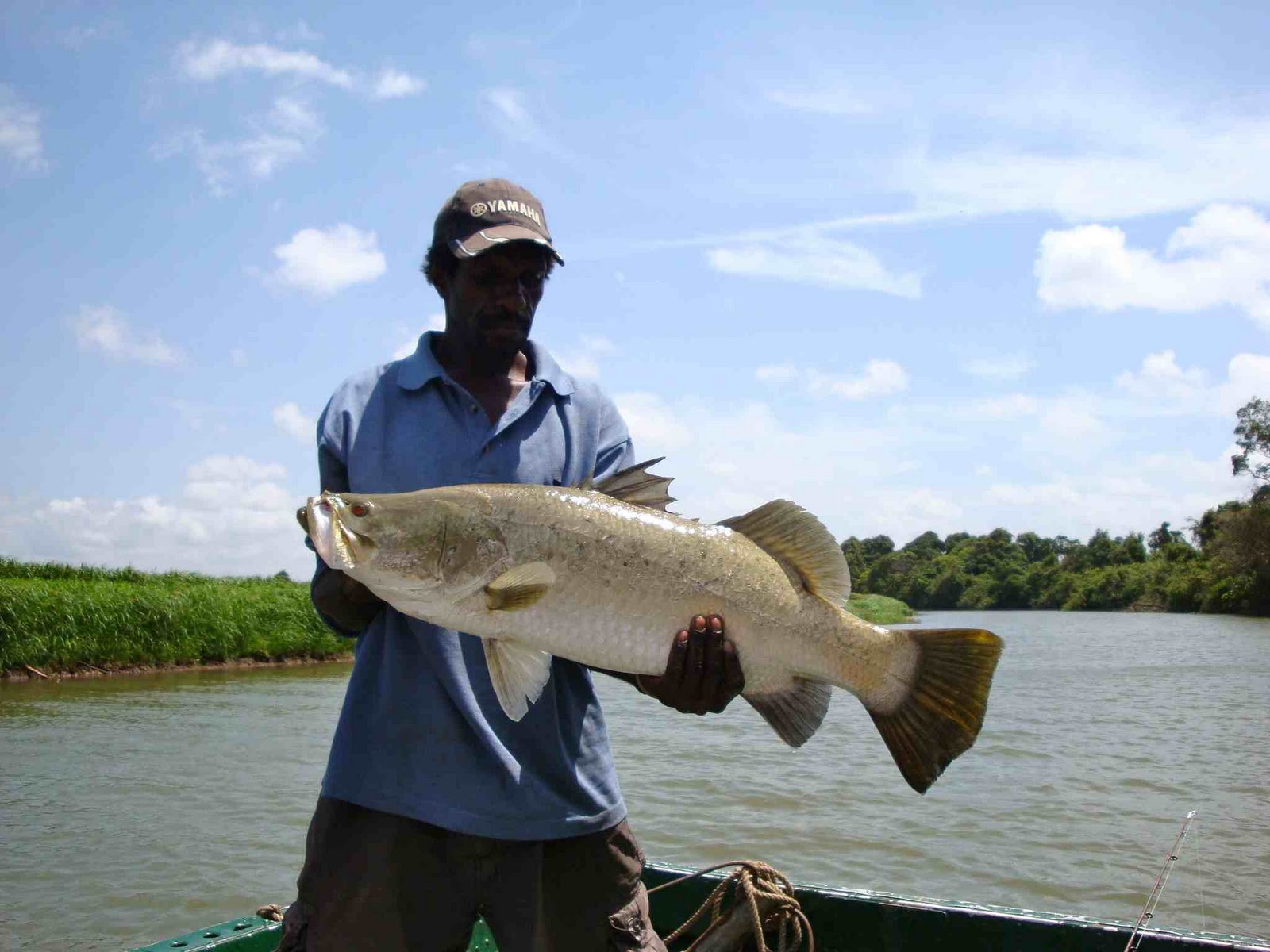
Bensbach is a wildlife wonderland. It is also accredited with being the Barramundi capital of the world so any visit would not be complete without a fishing expedition. We departed down river by flat bottom boat in the pale light of dawn passing awaking villages, deer and wallaby by the hundreds, crocs sliding off the river banks and teaming bird life. It took several hours but we did land our Barramundi which weighed in at 6kg…all credit to a skilled local fishing guide. That night we dined on the freshest Barramundi ever, reminisced on the past six weeks and bid emotional farewells. Bensbach marked the last night on our Coral Sea Safari and the successful completion of a great flying adventure….some might even say the flight of a lifetime! Six weeks, 6 countries, five Comanches and 10 adventurers. 

BAZ fishing 
6kg of Barramundi
Thursday morning, a 50 minute flight to Daru for exiting Customs and Immigration formalities, then a 45 minute hop across the Torres Strait to Horn Island and entry formalities into Australia….the Coral Sea Safari was over! Jim Peters (VH-ESL) and Jim Barry (VH-DCB) began their respective journeys home. Ian, Irene, Tony, Jan and the Bazflyers were looking forward to a couple of nights stay on Horn Island. 

Bazflyers at Bensbach
Since leaving home base in Taupo, New Zealand, ZK-BAZ has flown 30.5 hours. 

Return to Goroka

18 September 2011

It takes just 30 minutes to fly from Madang on the north coast to Goroka situated at 5200 feet in the Eastern Highlands of Papua New Guinea. The contrast between these two locations couldn't be greater. Hot and humid on the coast to cool and comfortable in the highlands. 

Comanche-5 flew into Goroka via the Goroka Gap which can be described as an 8,000 foot ridge between two 10,000 foot mountains. This short flight over high mountains and into the central highlands held an element of trepidation for some of the Comanche-5 pilots. However, the weather gods were good, the gap was wide open and in no time at all the Comanches were lined up again this time on Goroka airport.

Goroka International Primary School
The Bazflyers and family lived in Goroka from 1978-1983 and to our amazement not a lot had changed in the intervening 28 years. Our short day visit coincided with the Goroka Show, an annual event that showcases cultural groups from near and far. Going to the show we went past Goroka International Primary. Our boys received much of their early education at this school and Sandra was a teacher there. 

Show Crowd
Show Girl
Weather conditions in the highlands invariably produce late afternoon rain storms. Not wanting to be caught in adverse conditions Comanche-5 flew out of Goroka for Mount Hagen early in the afternoon.
Flying to Mt Hagen

Thursday, September 22, 2011

Wartime Rabaul


17 September 2011

Rabaul lays claim to the finest natural harbor in the Pacific. Perhaps because of this natural asset it also saw fierce action in both the First and Second world wars. 

Rabaul Harbour
Prior to the First World War, Germany occupied the northern coast of Papua and the eastern islands. Australia's early contribution to the Allied cause in the First World War involved the capture of German possessions in the Pacific. At dawn 11 September 1914 forces landed near Kokopo to capture an inland German radio station. After fierce fighting the Germans surrendered on 17 September 1914….97 years ago to this very day.

Japan entered the Second World War in December 1941 and very soon afterwards claimed Rabaul as a strategic base for its plan to capture Port Moresby. By early April 1944 Allied Forces had encircled Rabaul. Japanese naval and air force units had already abandoned the base leaving some 90,000 Japanese soldiers to withdraw overland. Mopping up and containing the remaining Japanese forces was left to the Australian Army, a task that involved much hard marching and fighting. Royal Australian and New Zealand navies and air forces also played a major part in operations which ended with the Japanese surrender

War Cemetery
Commonwealth dead in these campaigns number some 7,000. Their names are commemorated on headstones or memorials in the war cemeteries in Lae, Port Moresby, Rabaul, Fiji and New Caledonia. Exceptionally navel burials at sea are commemorated on memorials, at home ports for the Royal Navy, at Plymouth in England for the Royal Australian Navy, and at Auckland for the Royal New Zealand Navy.


Our visit to the well maintained Rabaul War Cemetery was a very moving experience. This cemetery contains 1,111 burials of the Second World War and commemorates 1,215 others who have no known grave. Nationalities include Indians, Fijians, Papuans and one New Zealander. The cemetery also contains 28 burials of the First World War. 

"Least we forget the cost of freedom"

Back to Rabaul


15 September 2011

All to soon it was time to leave Sanbis Resort…another gem in paradise. Sunrise heralded the prospect of a good flying day ahead for the run through to Papua New Guinea. 

Sanbis Resort
Prior arrangements had been made to pick-up Customs and Immigration officers from Gizo and ferry them by Sanbis speedboat over to Gizo airport. Like a mirage they appeared on time all smartly attired to stamp passports and the all important General Declaration that is required for an aircraft to enter the next country. Prior arrangements are notoriously casual in the Solomon Islands so the early arrival of government officials was greeted with some measure of disbelief. We had earlier been told news of our five 'private jets' flying through the Solomon Islands had made the national newspaper. Certainly the presence of five aircraft, private jets or otherwise, on Gizo airport at one time would have been a first since WWII. However, whatever the motivation departure formalities were completed ahead of expectations and by 9am Comanche-5 had settled in at 8,500 feet cruising on the direct track from Gizo to Tokua Airport, near Rabaul in Papua New Guinea.

Passing Bouganville
Rabaul is where our Coral Sea Safari was conceived almost exactly one year ago. The idea arose as the participants of today's Comanche-5 group of flyers were relaxing in the tepid sea-water off Kokopo Beach Resort…and so it was, in the manner of a ritual that we all gathered once again in the sea off Kokopo Beach Resort. As surely as the sunrise earlier that day it did not take long before the topic of conversation became focused on the prospect of a future safari somewhere else. Although we had yet to fly across Papua New Guinea before touching down in Australia, our return to Rabaul via the Coral Sea route symbolized the realization of a significant Bazflyer achievement.

Landing Tokua Airport
Tomorrow is the 36th anniversary of PNG Independence. The Bazflyers and their family were in Aitape in 1977 for the 2nd PNG Independence Day celebrations. How time passes…!